


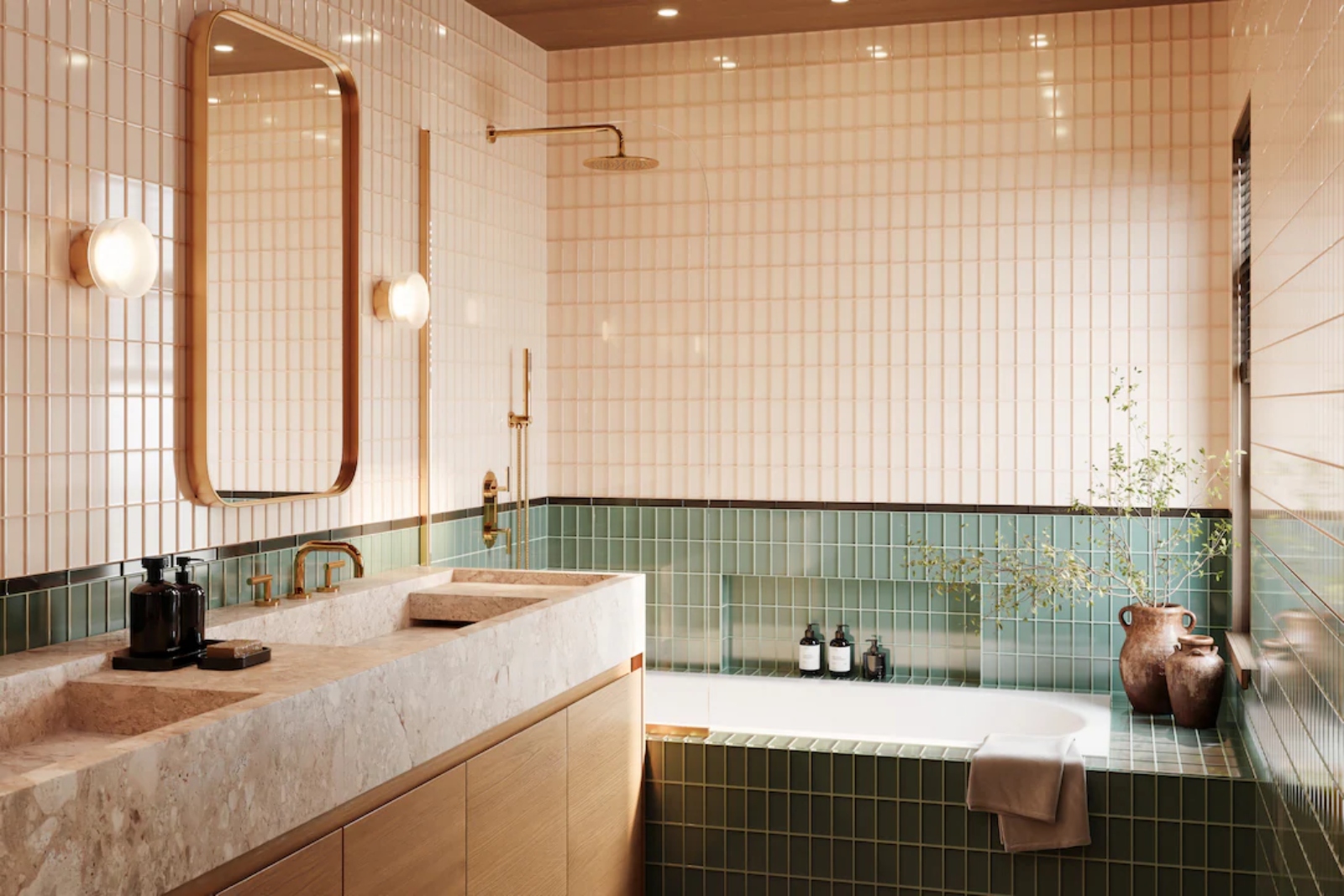
Tile has become a medium homeowners use for artistic expression in surprising new ways.
Mosaics, moody hues, antique finishes, fabric‑like and custom patterns are emerging as popular approaches to tile selection across the home, according to California-based manufacturer Fireclay Tile.
Color in particular — both in tile and grout — has taken on a more prominent role.
“It’s been a massive evolution of the early aughts when everybody’s flipping houses and ‘greige’ is the thing and you want to think of resale,” Jamie Chappell, vice president of brand and product for Fireclay Tile, said in an interview with Homes.com News.
“Now the luxury look is really this elevated level of personalization that shows you have good taste in materials and finishes in art and design.”

It’s an exciting shift for Chappell and CEO Eric Edelson, who say Fireclay’s humble beginnings 40 years ago as a small family business came from a love of color and glaze. Edelson, who took the helm in 2009, is leading the company through a growth phase, opening showrooms in major cities such as Chicago and Portland, Oregon, and is soon to follow a store in Culver City, California, outside Los Angeles.
Other tile makers offer a variety of colors and finishes beyond safe neutrals, such as Zia Tile and TileBar. But a strong demand remains for tiles that blend and enhance more than make a statement. Edelson, for example, personally has Fireclay's black Raven and white Calcite glazes in his home.

All of Fireclay’s products remain handmade, giving the brand freedom to essentially make any tile imaginable that’s permitted by clay and glaze. But in practice, the team takes a more controlled idea-to-tile approach that balances meeting the demands of homeowners and interior designers with the realities of running a business.
Design professionals have also described a move away from trends altogether, as homeowners prioritize spaces that reflect their personal identity rather than what is circulating in magazines or on social media.
Still, homeowners want spaces that also look good, even artistic, said Chappell.
“We’re starting to see this merge of art and design. Designers are creating spaces that are being treated, I would argue, as installation art in many ways,” she said. “And they’re creating a look and a feel that is authentic to the client and the project, and also, their signature look."
Tile can add color, pattern and texture, making it a prime medium for creating a visually rich, high‑end space. Here are the ways Fireclay says designers and homeowners are increasingly using its products:
Adding interest through varied tile orientations, textile patterns
Instead of spending money on a tile line with an existing pattern, Chappell sees designers creating their own patterns and cutting costs.

“If you know what you’re doing and work in horizontal bands, you can create some interesting horizontal patterns with size. That’s something we’re seeing a lot,” she said.
This could be subway tile laid horizontally, while one line through the layout switches orientations, swapping in vertical tiles. In one example, Chappell saw a designer use a $ 13-per-square-foot tile laid in this method, making it “look more expensive because the designer cared about those little details.”
Color patterning works the same way, with customers developing their own color mix across the same tile shape, even creating a repeating pattern to achieve a textile effect. For example, designers could achieve the appearance of plaid or gingham by intentionally laying out square tiles in four different colors, or by mixing skinny tiles and square tiles to create a thinner pattern.
The grout between the tiles offers an additional creative option, too. Chappell describes grout as the thread weaving these tiles together.
Grout with colors
Grout colors, a previously overlooked element, are being revisited for their impact on tile appearance and infusion of even more color, according to Chappell.
A purple tile with red grout, for example, could emphasize the warmth of the purple.
“Think about it like the warp and weft you see in a textile. The grout conversation has always been color match it to make it go away or contrast it to make the grid more prevalent. We typically recommend Laticrete, and you can do some fun stuff to lean into that patterning, even with one color of glaze, you can get more texture,” Chappell said.
And as a word from the wise: seal your ceramic tile when using a colored grout, she added.

Moody colors and textural finishes
The Fireclay ideation phase, when launching new products, starts with asking salespeople about the requests they're receiving from designers. Right now, Chappell is hearing moodier colors are in demand, like deeper reds and browns.
Those are the main hues in the popular Fireclay lines of Antique and Stains. Both also reflect another design demand from homeowners for imperfect, character-rich and artisan-like pieces. Both lines have heavy color variations, and Stains was launched last year based on the popularity of Antique, which is a top-selling finish.

“We started doing [Antique glaze] on a lot of our showroom floors, and it became very popular, which is a blessing and a curse. It’s one of our most difficult products to glaze,” said Edelson. “It’s absolutely beautiful and has incredible variation; we couldn’t keep up with demand.”
The Studio Glaze tile line also launched last year, in response to demand for greater variation and an organic aesthetic with textures, said Chappell. No two tiles are exactly alike.

Fun is in the details
There’s more attention being paid to details, from the color of grout to trim and architectural molding pieces.
Each small decision made intentionally turns the entire design into a more sophisticated, artistic piece. Customers are having fun with Fireclay's architectural moldings, which mimic traditional wood molding in ceramic tile, with dips and grooves.
Most brands offer these pieces in standard glazes, while Fireclay can glaze any trim piece in any existing glaze. Customers can add trim pieces in contrasting colors to their main tile, which creates a border around walls to add another layer of interest.
Mosaics rise in popularity
In two years, Fireclay saw a 30% increase in mosaic sales, and as a result, leaned further in, launching a new mosaics line this year. The collection features teeny tiles laid out to make up larger patterns, like Fireclay's classic checkerboard or daisy designs. The line also features mosaic borders, allowing the flooring to be set in a contrasting pattern.
“I was talking to one of our account managers and he’s doing a whole-home project where every bathroom, the pantry, the whole house has a special mosaic floor for that room only,” said Chappell.
It’s another result of homeowners wanting personalization and rooms to feel bespoke and unrepeatable, she added.